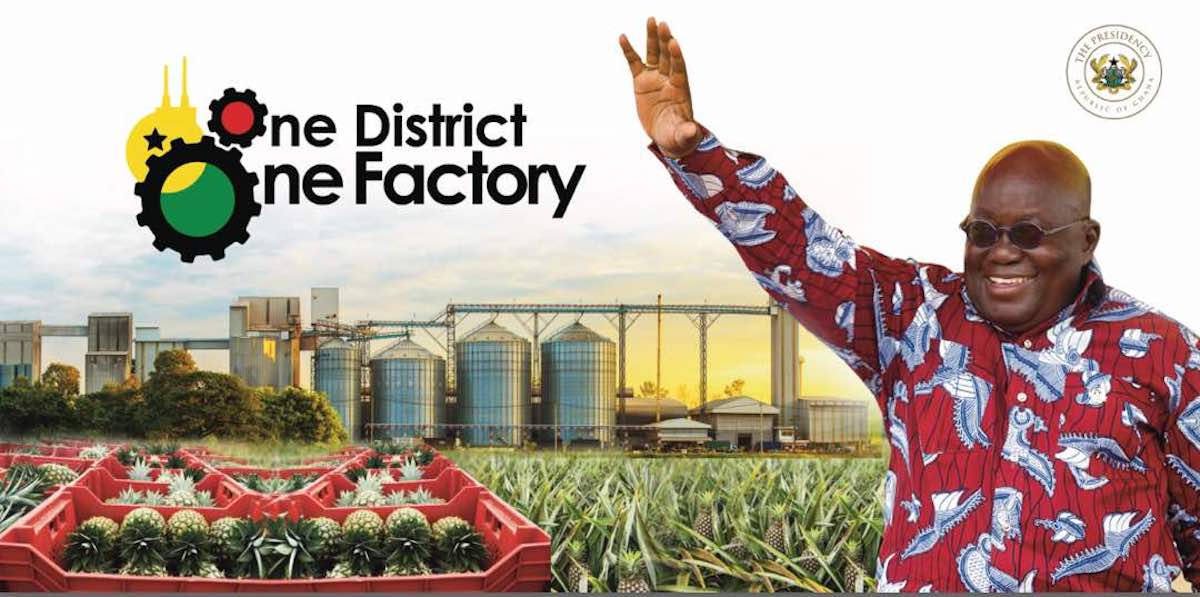
[dropcap]S[/dropcap]ome 185 business proposals have so far been cleared as ‘viable and bankable’, and are lined up for rolled out in 99 districts across the country under the ‘One District, One Factory’ programme.
According to Deputy Minister of Trade and Industry, Robert Ahomka-Lindsey, more than 40 percent of the companies are into manufacturing and another 40 percent are into agro-processing.
“The total value of the projects is close to US$1.8billion. So, we are very bullish about it. These 185 companies are bankable. They are businesses that have a good financial plan, good marketing plan, and good management among others,” Mr. Ahomka-Lindsey said at a forum held in Accra on Monday, which was organised by Bank of Africa and themed ‘Let’s Empower the Engine of Growth’.
“The purpose of One District, One Factory is to encourage the private sector to help develop, at least, one medium- to large-scale industrial enterprise that has the capacity to improve the economy of that district,” he said.
Government has emphasised that the programme will be a vehicle to revive the country’s manufacturing sector, and add value to agriculture.
The manufacturing sector, for instance, has performed abysmally for some years now, thereby aggravating the country’s youth unemployment situation.
The sector, which was the most promising and vibrant among all other sectors, took a surprising nose-dive in 2012 when growth tumbled from 28.4 percent in quarter one to a measly 1.8 percent in the next quarter.
Growth further plummeted to the negatives in quarter four of the same year, and remained in that state for the next two years.
In 2015 the consecutive two-year negative growth was overturned, as the sector recorded a 1.7 percent growth then moved to 3.4, 3.9, and 2.2 percent respectively in the last three quarters of the year.
Then, last year, it grew by 3.1, 5, 3.9, 2.7 percent respectively in all four quarters, making the 5 percent growth the highest recorded in the past five years.
Much of the sector’s woes have been attributed to three main factors: namely the energy crisis; high cost of power, even when it is available; and high taxes.
The situation has resulted in high cost of production, which has suffocated many companies and led to the collapse of some.